
You’re Grieving The Same Loss… But It Feels Like You’re Living In Two Different Worlds.
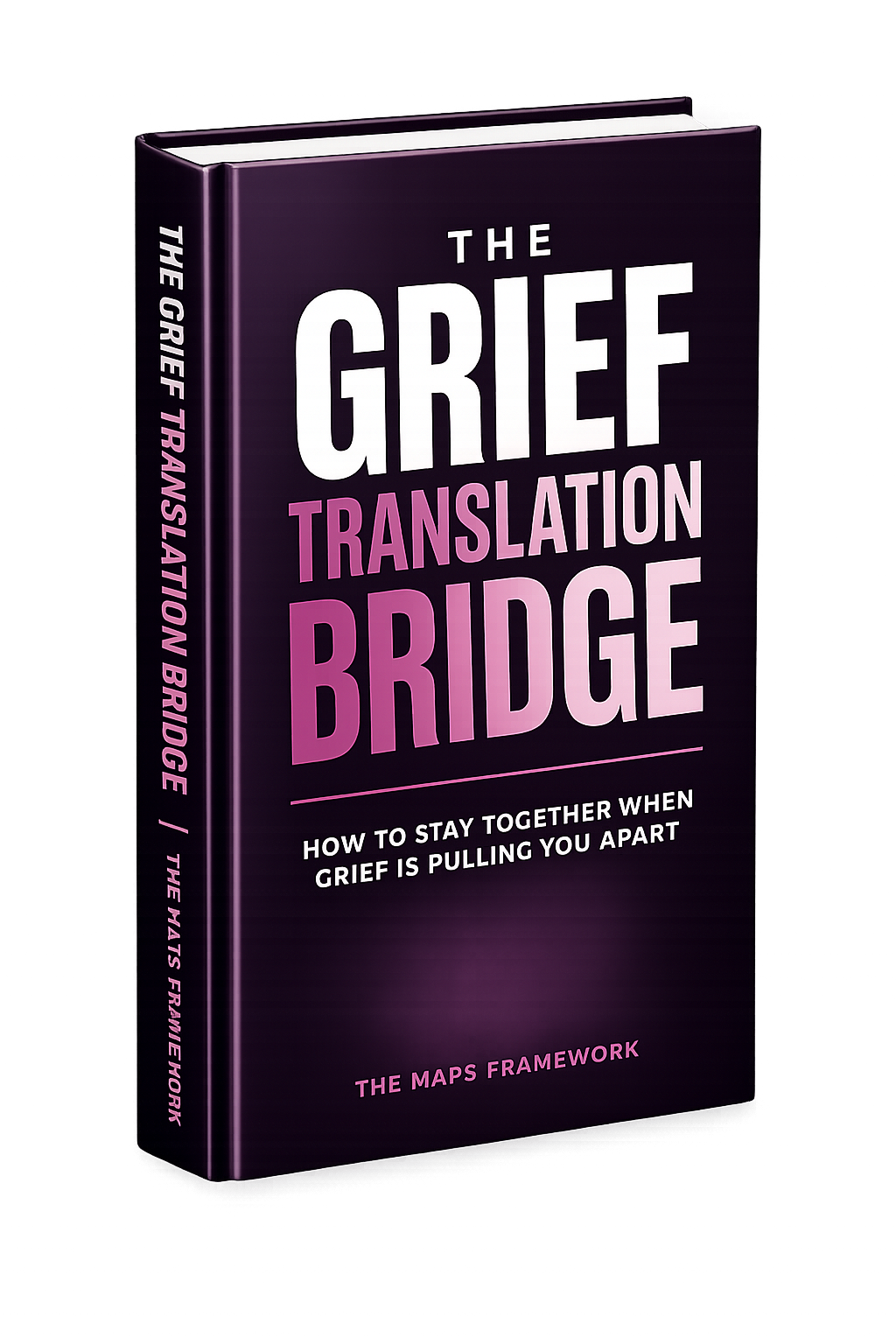
The Grief Translation Bridge eBook helps you and your partner stay connected when grief is pulling you apart.
Because this is one of the loneliest kinds of grief. Not being alone in the house. Not being alone in the loss. But being beside someone who should understand — and somehow feeling further away from them than ever.
What if the problem isn’t that one of you is grieving wrong, but that you’re grieving in different languages?
One of you may need to talk. The other may go quiet. One of you may cry openly. The other may stay busy. And when you don’t understand those differences, they start to feel personal.
You’re not necessarily loving differently. You’re grieving differently.
The Grief Isolation Protocol can quietly separate two people who are trying to survive the same loss.
When two people grieve the same loss in different ways, they can begin protecting themselves from each other without meaning to. You stop saying what you really feel because you do not want to start an argument.
You may translate your partner’s silence as indifference, their emotion as pressure, their need for space as abandonment, or their need to talk as criticism. And slowly, grief does not just separate you from the person you lost — it starts separating you from the person still beside you.
You may be experiencing this if...
The Grief Translation Bridge eBook
A compassionate guide for couples, partners, and close relationships trying to stay connected while grieving differently.
This is not a generic communication guide. It is not about forcing emotional conversations or deciding whose grief style is healthier, deeper, or more correct. It is about building a bridge between two internal worlds.
Map
Begin by mapping your own grief landscape and your partner’s. What do you each need when grief rises? What feels supportive? What feels overwhelming?
Announce
Learn how to name your grief weather before it turns into conflict, using simple phrases that create clarity before misunderstanding takes over.
Protect
Protect each other’s grief style from judgment by separating the grief need from the relational interpretation.
Synchronize
Build small rituals of connection that do not require identical emotional expression, so you can stay connected without emotional force.
What You Will Discover
This is for the couple who love each other, but feel lost inside the loss.
It is for the partner who feels unseen. The partner who feels misunderstood. The person who wants closeness but does not know how to ask for it.
You do not need to grieve the same way. You need to learn how to find each other inside the difference.
Stay Connected While Grieving Differently
Begin building a bridge of understanding, language, and compassion between two different grief worlds.
Frequently Asked Questions
Is this only for romantic partners?
No. Although it is especially helpful for couples and partners, the framework can also support close relationships where two people are grieving the same loss in different ways.
What if my partner does not want to talk?
This guide does not force emotional conversation. The MAPS Framework helps you understand silence, space, and different grief styles without immediately treating them as rejection.
Is this the same as the audio program?
No. The audio helps you understand why grief is creating distance. The eBook gives you structure, language, reflection tools, and a practical framework for building the bridge back to each other.
Does this mean hurtful behaviour is acceptable because someone is grieving?
No. Protecting a grief style does not mean excusing harmful behaviour. It means understanding the grief need underneath the behaviour while still maintaining healthy boundaries.
Is this therapy?
No. This is not a replacement for professional grief counselling, couples therapy, or medical care. If you are experiencing a crisis or serious relationship distress, please seek support from a qualified professional.
You are not enemies in this grief.
You are two people standing in different parts of the same storm. You do not need to force the same response. You need a bridge. And you can begin building it here.