
When Grief Makes It Hard To Think, Your Mind May Need Support — Not More Pressure.
Forgetfulness. Brain fog. Losing your train of thought. Reading the same thing repeatedly and still not taking it in.
When Grief Makes It Hard To Think is a gentle, practical guide created to help you understand why grief can sometimes affect concentration, attention, memory and mental clarity — and how to reduce the amount your mind is being asked to carry.
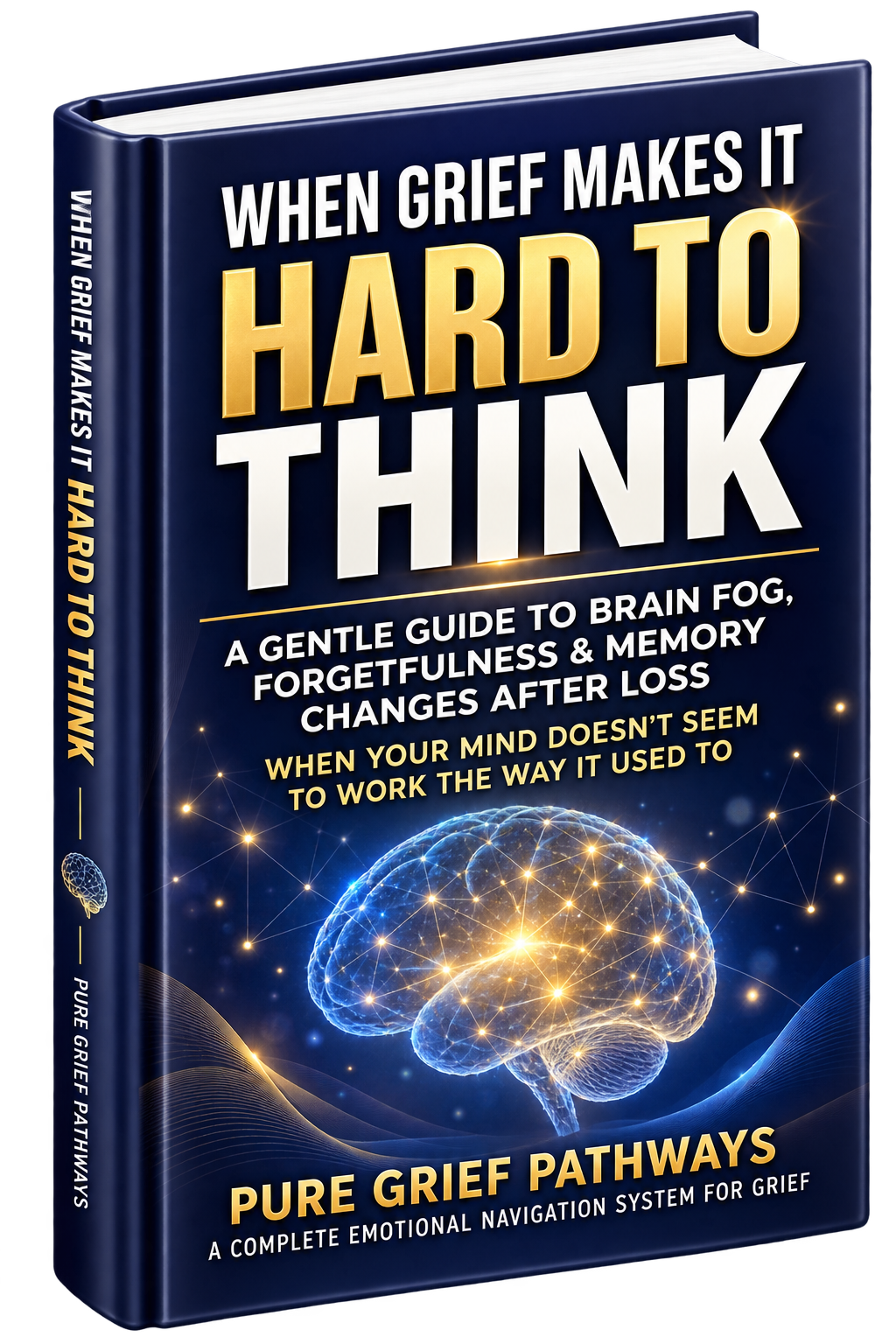
When Your Mind Does Not Feel Like Your Mind.
You walk into a room and forget why you went there. You read the same paragraph several times and still cannot remember what it said.
You put something somewhere safe and have no idea where that safe place was. Someone tells you something important and ten minutes later it has disappeared from your mind.
You may lose your train of thought halfway through a sentence. Appointments may slip your mind. Even relatively simple decisions can suddenly feel strangely difficult.
Difficulty thinking during grief does not mean you are failing. It may simply mean your mind is carrying far more than usual.
Grief is usually described in emotional terms: sadness, longing, anger and loneliness. But it can also affect attention, concentration, mental processing and memory.
Why Can Grief Create Brain Fog?
After a major loss, your mind may be trying to process extraordinary change while ordinary life continues demanding attention.
Memories, questions, regrets and constant reminders may be competing for attention.
Funeral arrangements, paperwork, finances and practical responsibilities may require decisions.
Changes in routines, identity and relationships can add additional mental load.
Poor sleep and emotional exhaustion can make concentration even more difficult.
Your attention may be pulled in several directions at the same time.
Ordinary thinking may simply become harder when too much is already happening in the background.
Seven Gentle Ways To Reduce Mental Load And Support Clarity.
These ideas are not about forcing your brain to work exactly as it did before. They are about reducing unnecessary cognitive pressure and giving your mind more practical support while it adjusts to a changed world.
Adjust The Expectation
Your current mental bandwidth may be different from your pre-loss capacity. Ask what is realistically manageable today.
Externalise Memory
Use notebooks, reminders, alarms, calendars and consistent places for important items rather than relying on memory alone.
Reduce Decisions
Simplify meals, routines, paperwork and everyday choices to protect limited cognitive energy.
Make Tasks Smaller
Instead of asking whether you can complete the whole task, ask for the smallest useful next step.
Support Attention
Pause, repeat, write down and deliberately register important information before moving on.
Create Daily Anchors
Use a few predictable points in the day to reduce the number of things your mind has to reinvent.
Know When To Seek Help
Do not automatically assume every change in memory, confusion or thinking is caused by grief.
Your Mind May Be Overloaded — Not Broken.
Imagine a computer with dozens of programs running simultaneously. Eventually everything begins to slow down.
That does not necessarily mean the computer is broken. It may simply be carrying too much at once.
You may not need to think harder. You may need to give your mind fewer things to hold.A Gentle Mental Clarity Reset For The Days When Thinking Feels Hard.
Keep this guide somewhere accessible and return to it whenever forgetfulness, concentration or decision-making begins to feel overwhelming.
You Have Not Suddenly Become Incapable.
Difficulty concentrating is not a character flaw. Forgetfulness is not a moral failure. Needing reminders does not make you less capable.
Download When Grief Makes It Hard To Think Free PDF • No registration required • Yours to keepExplore The Constellation Recovery Method.
This free guide introduces some of the supportive principles behind The Constellation Recovery Method, part of the Pure Grief Pathways support library.
The complete program is designed around the experience sometimes described as grief brain, grief fog or grief amnesia — those periods when thinking, remembering, concentrating and processing ordinary information can feel far more difficult after loss.
It is not about forcing yourself to think normally. It is not about pretending the cognitive effects of grief are not real. And it is not about treating every memory problem as grief.
Instead, The Constellation Recovery Method provides a structured pathway for reducing unnecessary cognitive load, supporting memory and attention, rebuilding useful structure and gradually creating more room for mental clarity.
There is absolutely no requirement to continue. The free guide is yours whether you choose to explore anything further or not.
Explore The Constellation Recovery MethodYour Mind May Need Time To Find Its Footing Again.
Your brain is being asked to process something extraordinary while ordinary life continues demanding attention.
Bills. Messages. Food. Work. Appointments. Other people. Decisions.
No wonder some things can feel harder.
Gradually, moments of clarity may begin returning. A task becomes easier. You remember something without checking. You concentrate for a little longer. A decision feels less overwhelming.
Do not demand that those moments arrive according to a schedule. Notice them when they do.
Your mind does not need punishment for struggling. It needs support while it finds its footing again.
Pure Grief Pathways
A Complete Emotional Navigation System for Grief