
When You Are Both Grieving, But Grief Is Pulling You In Different Directions.
One of you needs to talk. The other becomes quiet. One needs closeness. The other needs space.
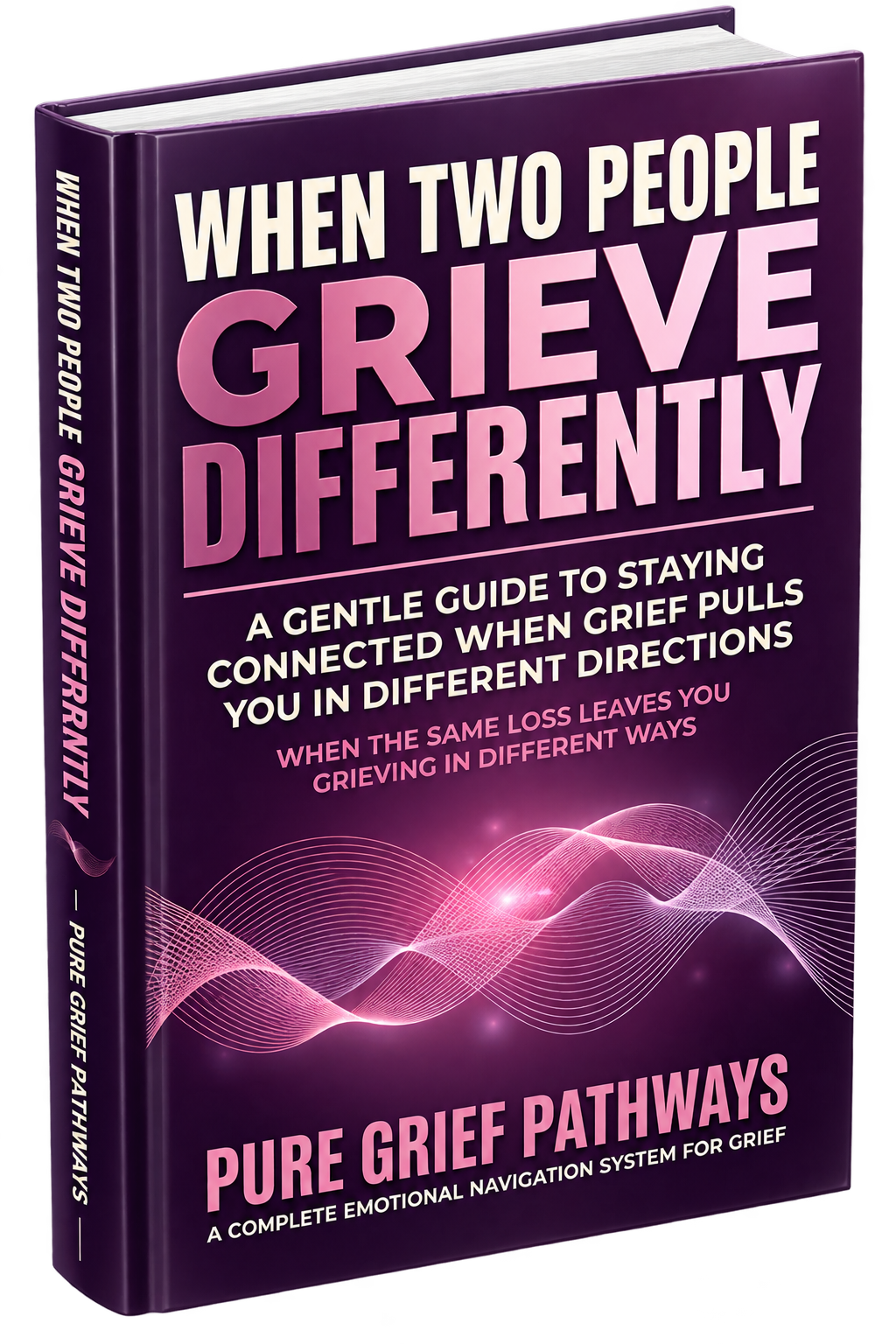
When Two People Grieve Differently is a gentle guide for couples who are living through the same loss but experiencing grief in very different ways — and want to protect their connection without expecting either person to grieve differently.
Two People Can Love Deeply And Still Grieve Completely Differently.
When two people experience the same loss, it can seem natural to assume they will grieve in similar ways.
You may both be mourning the same person, living through the same changed circumstances and facing many of the same reminders.
And yet one of you may need to talk repeatedly while the other becomes quieter.
One may cry easily while the other rarely cries. One may want photographs and memories nearby while the other finds those same reminders overwhelming.
Different grief does not necessarily mean different levels of love.
The difficulty begins when those differences become misunderstood.
Silence can look like indifference. A need for space can feel like rejection. Wanting to talk can feel overwhelming to somebody who processes internally. And wanting a little ordinary life can appear as though somebody is moving on too quickly.
Slowly, two people hurting from the same loss can begin hurting each other without either intending to.
Sometimes Grief Creates A Meaning That Was Never Intended.
The behaviour you see may not tell you the whole story of what your partner is carrying underneath.
They become quiet, and you begin wondering whether they care as deeply as you do.
You need conversation, while they seem to withdraw whenever grief is mentioned.
You want physical closeness while they need more emotional space.
One of you wants photographs and memories nearby while the other finds them overwhelming.
One returns to work or ordinary routines sooner, and the other interprets that as avoidance.
You may both be trying to support one another while quietly feeling misunderstood yourselves.
Seven Gentle Ways To Stay Connected When Grief Looks Different Between You.
The aim is not to make your grief identical. It is to create enough understanding for both experiences to have room inside the same relationship.
Recognise Different Grief Languages
One person may process through emotion and conversation, while the other processes through action, routine or practical responsibility.
Do Not Turn Difference Into A Verdict
A different grieving style does not automatically mean less love, less pain or less commitment.
Make Room For Talking And Silence
There can be room for conversation and quiet, closeness and space, without either person being wrong.
Replace Assumption With Curiosity
Behaviour tells you what someone is doing. It does not always tell you why they are doing it.
Look Beneath The Argument
Conflict may sometimes be carrying sadness, fear, helplessness, exhaustion or another grief-related emotion underneath it.
Stop Trying To Fix Each Other
Support can sometimes mean listening, acknowledging and staying rather than trying to remove the grief.
Create Small Places Of Connection
A simple check-in, shared memory, quiet walk or gentle question can create space for both forms of grief to exist.
Your Partner's Way Of Grieving Does Not Invalidate Yours.
Grief is not a test in which two people should produce matching answers.
There is no correct amount of crying. No correct amount of conversation. No correct amount of visible sadness.
And there is no single correct moment when laughter, ordinary life or moments of relief should return.
You can both be right about what you need, even when those needs are different.A Gentle Guide For When Different Grieving Styles Begin Creating Distance.
Return to this resource whenever grief starts making you interpret your partner's behaviour through your own pain rather than asking what may be happening underneath it.
You Do Not Need Identical Grief To Stay Connected.
You may never experience the loss in exactly the same way. You do not need to.
What matters is learning how to recognise, explain and make room for both experiences.
Download When Two People Grieve Differently Free PDF • No registration required • Yours to keepExplore The Grief Translation Bridge.
This free guide introduces some of the supportive principles behind The Grief Translation Bridge, part of the Pure Grief Pathways support system.
The complete program was created for couples who find that different grieving styles are beginning to create misunderstanding, emotional distance or the feeling that they are grieving beside one another rather than together.
It is not about deciding who is grieving correctly. It is not about forcing one person to become more emotional or asking the other to become less emotional.
And it is not about making two people grieve in exactly the same way.
Instead, The Grief Translation Bridge provides a structured pathway for recognising what may be happening beneath different grief responses, translating emotional needs more clearly and creating healthier ways of communicating when loss makes connection difficult.
There is absolutely no requirement to continue. The free guide is yours whether you choose to explore anything further or not.
Explore The Grief Translation BridgeDifference Does Not Have To Become Disconnection.
You may never experience this loss in exactly the same way.
One of you may always need more conversation. The other may always need more quiet.
One may find comfort in memory. The other may need temporary distance from reminders.
One may want closeness. The other may occasionally need space.
None of those differences automatically mean that one of you loves more, hurts more or is coping better.
The important shift is moving away from: “Why aren't you grieving the way I am?”
And towards: “How can we make room for both of us?”
Explain rather than assume. Ask rather than interpret. Allow space without disappearing. Offer closeness without demanding it.
You do not need identical grief to maintain a loving connection.
You need enough understanding to recognise each other inside the difference.
Pure Grief Pathways
A Complete Emotional Navigation System for Grief