
Your Child May Seem Okay Today — And Meet Their Grief Differently As They Grow.
Children do not experience grief in one fixed way. They grow. Their understanding changes. And sometimes an old loss can suddenly carry a completely new meaning.
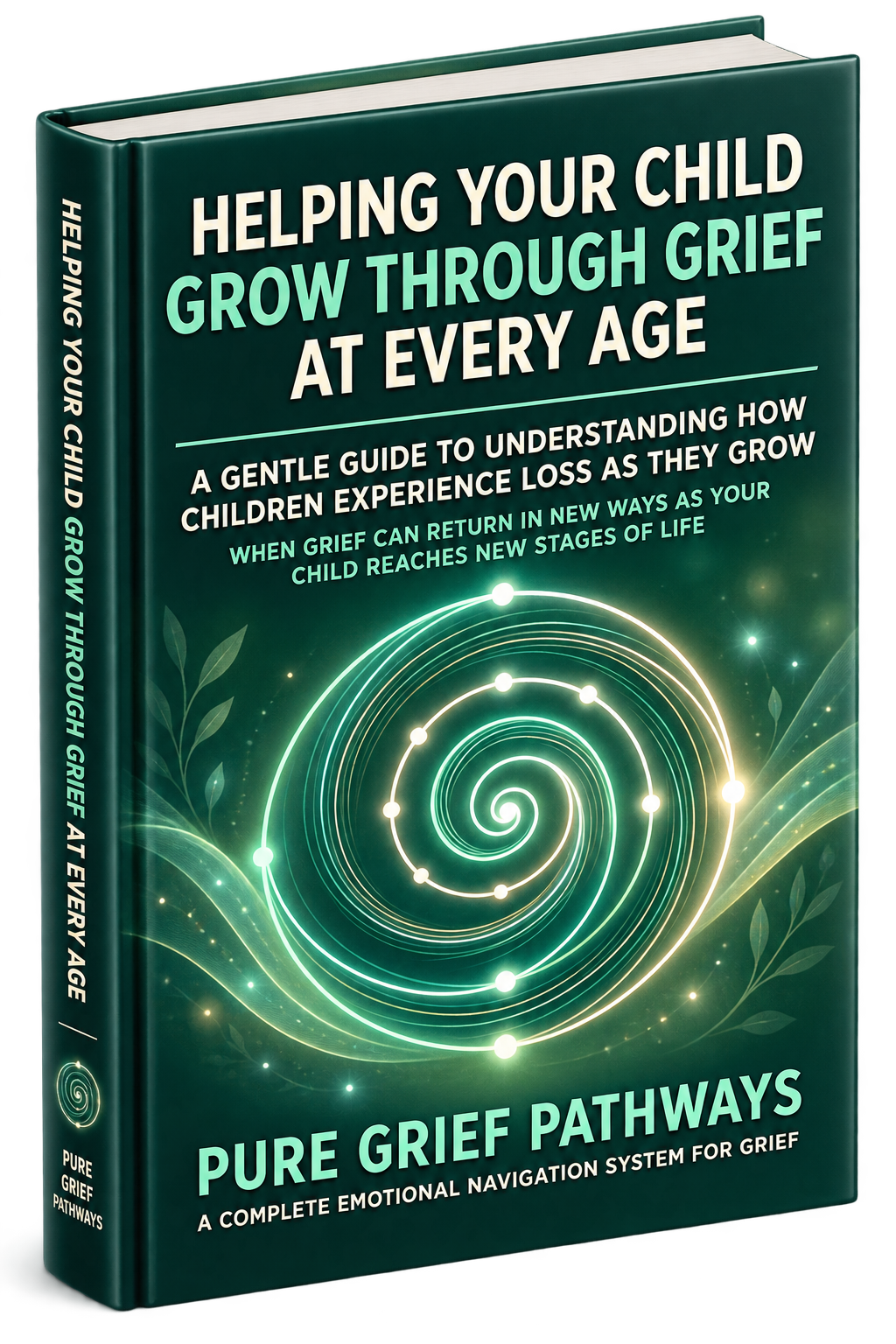
Helping Your Child Grow Through Grief At Every Age is a gentle guide for parents and caregivers who want to understand how children experience loss, why grief can return at different developmental stages, and how to remain a steady source of support without needing to have every answer.
Children Can Grieve Deeply Without Appearing Sad All The Time.
One of the most confusing parts of supporting a grieving child is that their grief may not look anything like adult grief.
A child may cry one moment and ask to play the next. They may talk about the person who died and then suddenly become completely absorbed in a game, a snack or something that happened at school.
This does not necessarily mean they have forgotten. It does not mean the person did not matter. And it does not mean they have somehow recovered unusually quickly.
Children often move in and out of intense emotion because they can only remain with feelings that large for so long.
A child can be grieving even while laughing, playing and taking part in ordinary life.
Their grief may appear through questions, behaviour, play, sleep, clinginess, anger, silence, physical complaints or repeated curiosity about what happened.
And as they grow, their understanding of the loss can grow too.
The same death may mean something very different to a child at five, eight, twelve, sixteen or twenty because their understanding of relationships, permanence, identity and the future has changed.
You Do Not Need To Become The Perfect Parent With The Perfect Words.
Supporting a grieving child can bring enormous pressure. You may be grieving too, while simultaneously wondering whether you are saying enough, doing enough or getting it right.
Your child seems fine one moment and deeply upset the next.
They keep asking the same questions even though you have already answered them.
Their grief seems to appear through behaviour rather than words.
A birthday, school event, holiday or milestone suddenly brings the loss back strongly.
You worry that mentioning the person who died will upset your child.
You are trying to support your child while carrying your own grief at the same time.
Seven Gentle Ways To Support Your Child As Their Understanding Of Grief Grows.
You do not need to fix grief for your child. You can help them learn that grief can be carried, questions are welcome, memories are safe and they do not have to face difficult feelings alone.
Understand Their Grief
Recognise why children can move quickly between sadness, play, curiosity and ordinary childhood life.
Expect Grief To Grow With Them
Understand why the same loss can return with new meaning as your child's emotional and cognitive understanding develops.
Release The Need For Perfect Words
Offer honest, age-appropriate language and steady presence rather than putting pressure on yourself to provide flawless explanations.
Listen Beneath The Question
Learn to notice when a factual question may also contain a deeper need for safety, reassurance or emotional understanding.
Notice Behaviour As Communication
Recognise that grief can sometimes appear through sleep, clinginess, irritability, concentration, withdrawal or stronger emotional reactions.
Keep Memory Available
Allow the person who died to remain part of family language through stories, photographs, traditions and natural remembrance.
Become The Steady Lighthouse
Provide a reliable point of orientation your child can return to as grief changes, questions evolve and new milestones appear.
You Do Not Have To Fix Your Child's Grief To Help Them Through It.
You do not need every answer.
You do not need to prevent every difficult emotion.
You do not need to predict how they will feel at every age or milestone.
And you do not need to hide every part of your own humanity in order to make your child feel safe.
You can be a grieving person and a steady parent at the same time.A Gentle Guide You Can Return To As Your Child Grows.
Because children's understanding changes with development, this is not necessarily a resource you will read only once. Return whenever new questions, behaviours, milestones or stages of life bring another layer of the loss into view.
Your Child Does Not Need You To Have Every Answer.
They need somewhere safe for the questions. Somewhere the person who died can still be remembered. Somewhere difficult feelings do not have to be hidden.
And someone steady enough to keep returning to them as their understanding grows.
Download Helping Your Child Grow Through Grief At Every Age Free PDF • No registration required • Yours to keepExplore The Grief Spiral Method.
This free guide introduces some of the supportive principles behind The Grief Spiral Method, part of the Pure Grief Pathways support system.
The complete program is designed to help parents and caregivers understand how grief can reappear across developmental stages and how to respond with age-appropriate communication, emotional steadiness and compassionate structure.
It is not about forcing your child to talk. It is not about making grief disappear. It is not about expecting them to follow a particular timetable. And it is not about trying to become a perfect parent who always knows exactly what to say.
Instead, The Grief Spiral Method provides a structured pathway for noticing how grief is showing up now, understanding what your child may need at their current stage, and creating a secure foundation they can return to as they continue to grow.
The program uses the CLIMB framework: Chart what you notice. Listen for the feeling or need underneath. Invite conversation without demanding it. Match your support to your child's current age and understanding. And Bookmark important questions, memories and milestones so you can return to them later.
There is absolutely no requirement to continue. The free guide is yours whether you choose to explore anything further or not.
Explore The Grief Spiral MethodYour Child Can Keep Growing While Carrying Love, Memory And Grief Forward.
A conversation that was enough when they were six may need a different explanation when they are ten.
A memory that once felt simple may carry a completely different meaning in adolescence.
A milestone may suddenly reveal an absence your child could not fully understand when they were younger.
None of this means they are going backwards.
It means they are growing.
And as they grow, they may meet the same loss from new places in their developing life.
Your role is not to prevent every wave.
It is to remain a reliable point of orientation while your child gradually learns that waves can come and go.
Keep the door open for questions. Keep memory available without pressure. Maintain structure while remaining compassionate. Allow their grief to belong to them. And remember that your own grief matters too.
Over time, the message you give your child can become larger than any single conversation:
Grief can be carried. Love can continue. Questions are welcome. And difficult feelings do not have to be faced alone.
You do not need to fix grief. You can be their steady lighthouse.
Pure Grief Pathways
A Complete Emotional Navigation System for Grief