
When You Are Afraid Of Forgetting, You Do Not Have To Remember Everything Perfectly.
Their voice. Their expressions. The phrases they used. The tiny habits you never imagined needing to remember deliberately.
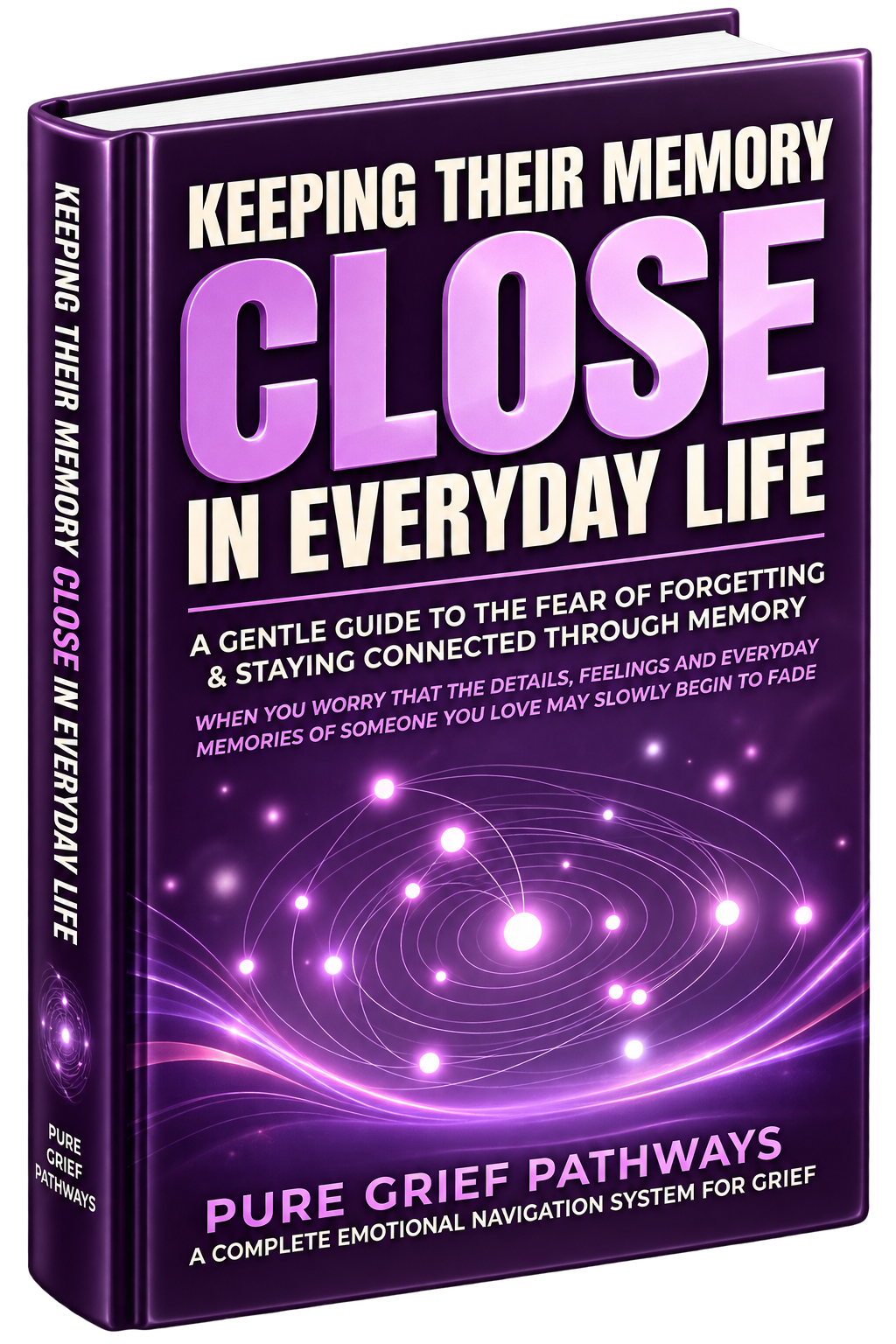
Keeping Their Memory Close In Everyday Life is a gentle, practical guide created to help you understand the fear of forgetting, reduce the pressure to preserve every detail and find meaningful ways to stay connected through memory.
The Fear Of Forgetting Can Feel Like Losing Them Again.
There is a particular fear that can appear after someone important dies.
It is not only the pain of missing them. It is the fear that, as time passes, you might begin to lose parts of them too.
Perhaps you suddenly realise you cannot remember exactly how their voice sounded when they called your name. Maybe a familiar expression is harder to picture. Perhaps one of the small details of ordinary life feels less clear than it once did.
Difficulty recalling every detail does not mean the person you love is disappearing from you.
Memory is not a perfect recording of a life. It is something more human, more emotional and more complex.
Some memories may remain vivid. Others may soften. Some may seem unreachable and then suddenly return through a song, a smell, a photograph, a place or a familiar phrase.
You do not have to remember everything perfectly for your love to remain real.
Why Can The Fear Of Forgetting Become So Powerful?
After someone dies, memories can begin to feel extraordinarily precious. And that can create enormous pressure to protect every detail.
You may worry that forgetting one detail means you are somehow losing them again.
You may mentally test yourself to see whether you can still hear their voice or picture their face.
You may feel pressure to save every photograph, message, story or object.
A memory that feels difficult to retrieve may immediately create fear.
You may worry that time itself is creating greater distance between you and the person you love.
New experiences may bring guilt because they do not include the person who died.
Seven Gentle Ways To Create A More Secure Relationship With Memory.
The aim is not to create a perfect archive of someone’s life. It is to reduce the pressure around remembering and give meaningful memories a safe place to remain.
Separate A Detail From The Person
Forgetting one detail is not the same as forgetting someone. A relationship was built through far more than one memory.
Trust That Memory Can Return
A memory that feels inaccessible today may return through music, places, smells, photographs or unexpected moments.
Notice What They Changed In You
Their influence may still live in your values, habits, humour, routines, choices and ways of seeing the world.
Value The Ordinary Memories
Sometimes the things you miss most are not major events, but the tiny details of everyday life you once took for granted.
Release The Pressure To Capture Everything
You do not need to preserve an entire lifetime today. Remembrance can unfold gradually.
Create Small Memory Anchors
Give meaningful memories somewhere to rest through photographs, writing, music, messages, stories or treasured objects.
Let Memory Travel With You
Keeping someone close does not require your life to remain frozen. Their significance can move forward with you.
You Are More Than An Archive Of Memories.
A meaningful relationship leaves behind more than recollections.
The person you love may still be present in the way you treat people, the music you listen to, the things you notice, the values you carry and the choices you make.
Their influence became woven into who you are.
You are not merely carrying memories of them. You are carrying ways in which loving them changed you.A Gentle Guide For The Moments When You Become Afraid A Memory Is Fading.
Return to this resource whenever remembering begins to feel like something you must manage perfectly or whenever time makes the connection feel fragile.
You Are Not Responsible For Keeping Every Detail Alive.
Some memories may soften. Some may unexpectedly return. Others may remain clear for the rest of your life.
You are allowed simply to carry what matters.
Download Keeping Their Memory Close In Everyday Life Free PDF • No registration required • Yours to keepExplore The Memory Anchoring System.
This free guide introduces some of the supportive principles behind The Memory Anchoring System, part of the Pure Grief Pathways support library.
The complete program was created for people who find the fear of forgetting becoming a recurring part of grief — worrying about fading memories, losing emotional connection or struggling with how to keep someone meaningfully present in everyday life.
It is not about preserving every detail. It is not about keeping yourself emotionally fixed in the past. And it is not about creating a perfect archive of the person you lost.
Instead, The Memory Anchoring System provides a structured pathway for intentionally anchoring meaningful memories, reducing anxiety around forgetting and creating a more secure relationship with remembrance.
The aim is to help memory have a safe place within the life you are continuing to live.
There is absolutely no requirement to continue. The free guide is yours whether you choose to explore anything further or not.
Explore The Memory Anchoring SystemYou Do Not Have To Hold An Entire Lifetime In Your Mind.
You will probably forget some details. All human beings do.
Some memories may become softer. Others may return unexpectedly. Some may remain extraordinarily clear for the rest of your life.
But the significance of a person cannot be measured by the number of details you can consciously retrieve.
They existed. You knew them. You loved them. They affected your life. They became part of your story.
None of those truths disappear because you cannot remember every conversation or reconstruct every ordinary day.
Perhaps one remembered moment can be enough. One phrase. One expression. One story. One ordinary afternoon.
Sometimes one remembered moment can hold an extraordinary amount of love.
Pure Grief Pathways
A Complete Emotional Navigation System for Grief