
You’re Not Just Afraid Of Losing Them. You’re Afraid Of Losing The Memories Too.
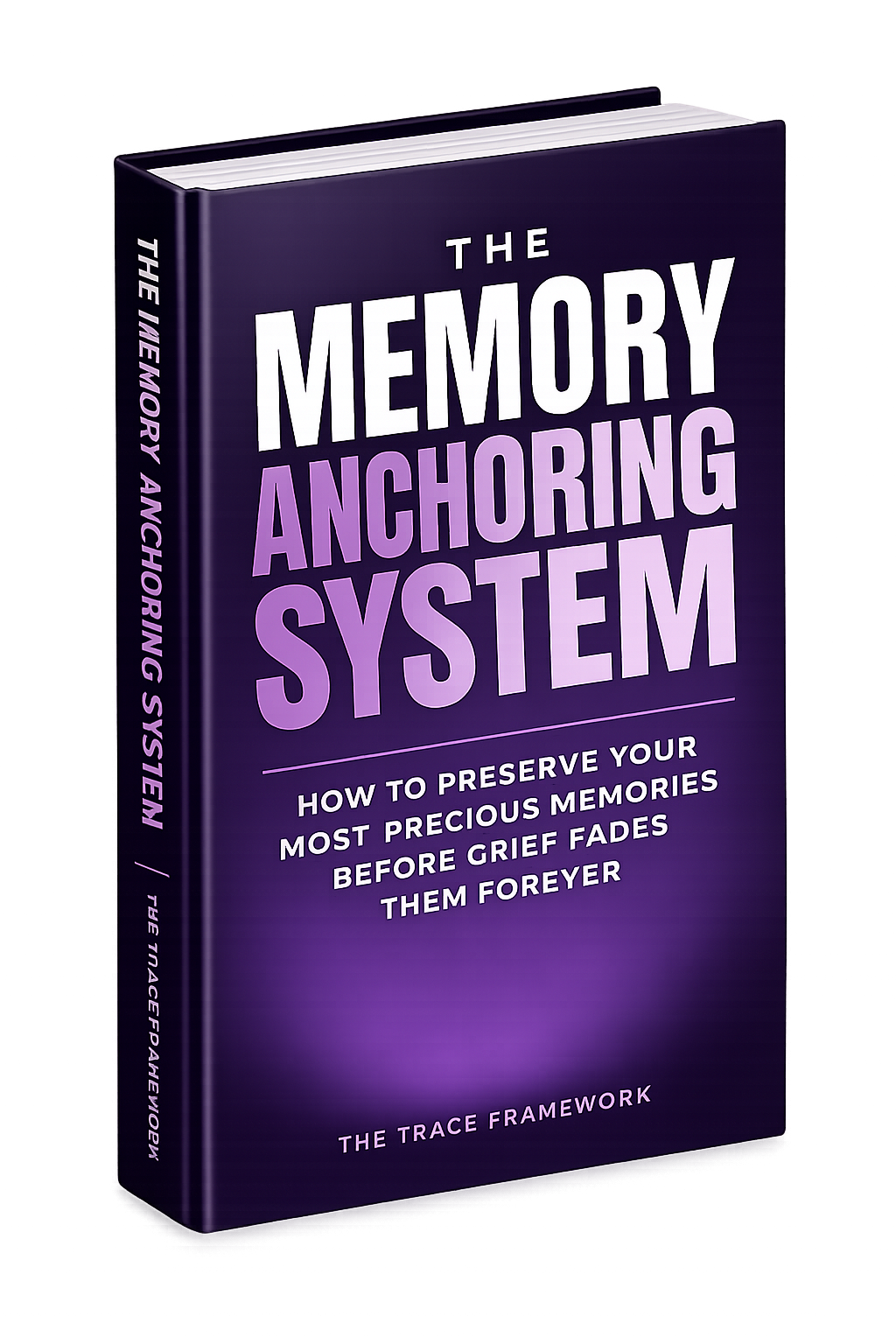
The Memory Anchoring System eBook helps you preserve your most precious memories before grief, time, and emotional overwhelm begin to blur the details.
Because this fear is different. It is quieter than the first loss, but sometimes it feels just as terrifying — the laugh, the phrases, the stories, the small details that made them unmistakably them.
What if your memories aren’t fading because you didn’t love enough, but because grief changes how memory works?
You may be trying to hold on with everything you have — photos, stories, objects, and quiet attempts to remember their voice before sleep. But some memories still feel like smoke.
Your memories need more than storage. They need anchoring.
Grief fog can make even your most precious memories harder to reach.
Grief does not only affect your emotions. It affects attention, recall, and what your brain stores clearly versus what it struggles to retrieve.
When you are grieving, your mind is often overloaded just trying to survive the day. So fragile memories — especially the small, sensory, ordinary ones — can become harder to access. Not because they don’t matter, but because no one has shown you how to anchor them properly.
You may be experiencing this if...
The Memory Anchoring System eBook
A practical, compassionate guide that helps you capture, preserve, and strengthen your most precious memories before grief and time make them harder to reach.
This is not about obsessing over the past. It is not about refusing to live. And it is not about trapping yourself inside memories. It is about protecting what matters, so the person you love remains accessible in a way that feels rich, specific, and real.
Touch
Begin with physical or sensory contact — an object, photo, scent, piece of clothing, place, or song that gives the memory a doorway.
Record
Capture the memory while it is active, including the atmosphere, words, movements, small details, and feeling of the moment.
Anchor
Attach the memory to a stable cue, such as a phrase, object, image, sound, ritual, or written prompt that gives it a home.
Capture
Preserve the memory in a clear format, such as written notes, voice recordings, memory cards, printed pages, or a digital folder.
Evoke
Return to the memory gently and intentionally, not to reopen pain, but to keep the pathway alive and accessible over time.
What You Will Discover
This is for the person who is terrified of forgetting the little things.
It is for the person lying awake trying to remember the exact sound of their laugh. The person who knows a memory is there but cannot quite reach it.
It is for the person afraid that time will take more than it already has — not just the big moments, but the small ordinary ones that made them them.
Preserve Your Most Precious Memories
Begin anchoring the details, stories, sounds, and moments you never want to lose.
Frequently Asked Questions
Is this about living in the past?
No. This guide is about protecting meaningful memories so you do not have to panic about losing them. Anchoring memories can help you carry them more peacefully, not stay trapped inside them.
What if some memories already feel faded?
The TRACE Method can still help you work with what remains. Sensory prompts, objects, places, sounds, and written cues may help you access details that feel hidden behind grief fog.
Is this the same as the audio program?
No. The audio helps you understand why the fear of forgetting feels so painful. The eBook gives you structure, prompts, and a repeatable process for preserving memories before they become harder to access.
Do I need special tools?
No. You can begin with a notebook, a phone voice recorder, photos, objects, songs, or simple written prompts. The most important part is the anchoring process, not expensive tools.
Is this therapy?
No. This is not a replacement for professional grief counselling, therapy, or medical care. It is a practical grief support guide that can sit alongside other forms of support.
The memories are not meaningless because they feel fragile.
They are precious because they are fragile. And you do not have to leave them unprotected. Start anchoring them now — one memory, one detail, one piece of them at a time.